SOAP: Simple Object Access Protocol
In the modern era of distributed computing, the exchange of information is often treated with a casual indifference. We rely on lightweight, loosely defined formats that prioritize speed over structural integrity. However, there exists a world where ambiguity is the enemy of progress.
This is the world of the Simple Object Access Protocol, or SOAP. To understand SOAP is to understand the fundamental necessity of rigorous standards in high-stakes environments. It is not merely a method of sending data; it is a philosophy of communication based on strict contracts.
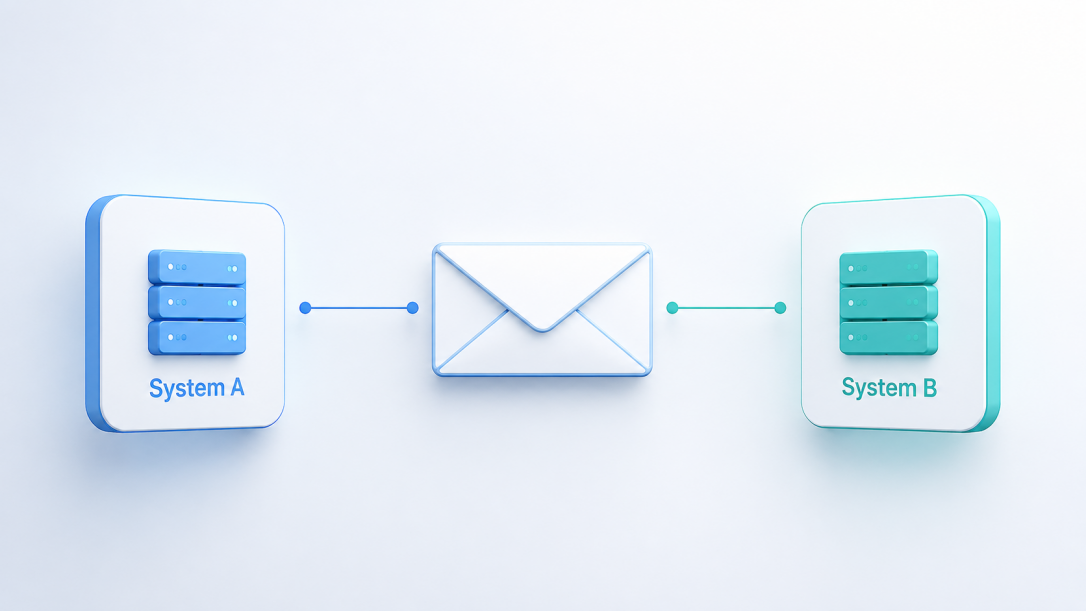
Before we explore the technical syntax, we must define its purpose. SOAP was designed to allow applications running on different operating systems to communicate over the internet. It achieved this by utilizing XML, the eXtensible Markup Language, as its universal medium.
The Genesis of a Standard
In the late 1990s, the software industry faced a crisis of fragmentation. Systems built in Java could not easily talk to systems built in C#. The industry needed a bridge that was independent of the underlying platform.
SOAP emerged as that bridge. It was adopted by the World Wide Web Consortium (W3C) as a recommendation, transforming it from a corporate project into a global standard. It provided a level of predictability that the industry had never seen before.
While newer architectures like REST emphasize the Resource, SOAP emphasizes the Procedure. It is a protocol for Remote Procedure Calls (RPC), allowing one system to invoke logic on another as if it were local.
Structure of SOAP
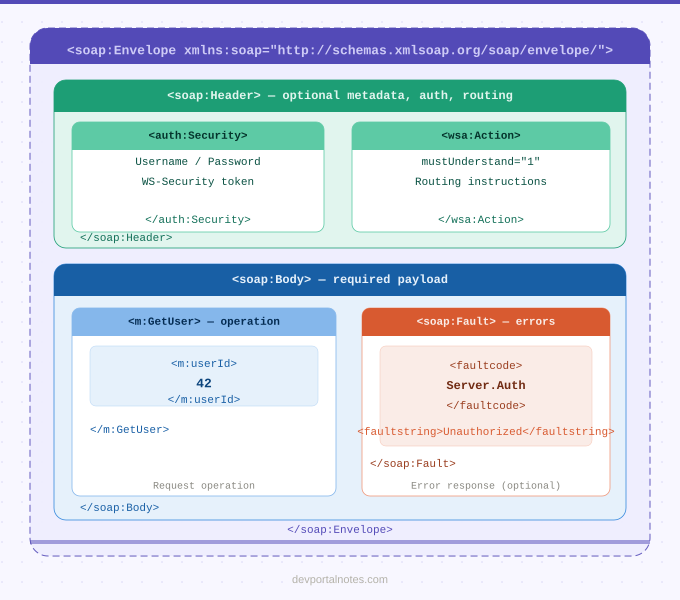
The structure of SOAP is wrapped in what we call the "Envelope." This is the root element of the XML document. It acts as the boundary of the message, declaring to any receiving server that what follows is a formal SOAP request. Inside envelope, you have a header for metadata (like auth) and a body for the actual data.
The Header
Within the Envelope, we have the Header. This is an optional yet powerful section. It is used to pass metadata that is not part of the primary payload.
For example, a Header might contain a complex authentication token. It might also include routing instructions for middle-tier servers. This separation of concerns make sure the Body to remain focused solely on the business logic of the request.
Most importantly, the Header supports the "mustUnderstand" attribute. If this attribute is set to true, the receiver must process the header or fail the entire request. This ensures that security or transactional requirements are never ignored by a lazy implementation.
The Body
This part is the heart of the message. It contains the actual data meant for the end application. If you are querying a database for a user’s medical record, the user ID resides here.
The Body is where the Remote Procedure is defined. In a banking application, the Body might contain an instruction like TransferFunds. It specifies the source account, the destination, and the exact amount to three decimal places.
This precision is mandatory. Because SOAP relies on XML Schemas (XSD), the data types must match exactly. If the server expects an integer and you send a string, the message is rejected before the application logic even sees it.
How SOAP Handles Error?
No system is perfect, and networks are inherently unreliable. SOAP manages this reality through a specialized sub-element located within the Body; the "Fault" element. It appears only when an error occurs.
The Fault element provides a structured way to report what went wrong. It includes a "FaultCode" for machine parsing and a "FaultString" for human readability. It may also include "Detail" for specific debugging information.
You can compare this to other systems that might return a generic "404" or "500" error. SOAP tells you exactly which part of the XML failed validation. It identifies whether the error was caused by the client or the server.
A Sample of the Protocol in Practice
Let us examine a concrete example of a request sent to a sophisticated inventory system. Notice how namespaces prevent the mixing of different data definitions.
<?xml version="1.0"?>
<soap:Envelope xmlns:soap="[http://www.w3.org/2003/05/soap-envelope/](http://www.w3.org/2003/05/soap-envelope/)"
               xmlns:inv="[http://www.global-logistics.org/inventory](http://www.global-logistics.org/inventory)">
  <soap:Header>
    <inv:TransactionID>TR-99821-X</inv:TransactionID>
    <inv:SecurityToken>f47ac10b-58cc-4372-a567-0e02b2c3d479</inv:SecurityToken>
  </soap:Header>
  <soap:Body>
    <inv:GetProductAvailability>
      <inv:SKU>APL-IPH-15-PRO</inv:SKU>
      <inv:WarehouseCode>WH-NORTH-01</inv:WarehouseCode>
    </inv:GetProductAvailability>
  </soap:Body>
</soap:Envelope>
The response to this message would be equally structured. It would return the stock levels, the last update timestamp, and perhaps a list of nearby warehouses with available stock.
WSDL: The Master Blueprint
One cannot discuss SOAP without mentioning the WSDL. The heart of any SOAP API is the WSDL (Web Services Description Language). It’s an XML file that describes exactly what the service does, what arguments it takes, and what it returns.
In other words, a WSDL file defines the "Endpoints" where the service lives. It lists every operation the service can perform. It describes the exact format of the input messages and the expected output messages.
This allows for the automation of client creation. In many professional environments, a developer simply points a tool at a WSDL URL. The tool then generates all the necessary code to communicate with that service. This is the "Contract-First" approach.
The Superiority of WS-* Standards
Why do we continue to use such a heavy protocol? The answer lies in the WS-* (Web Services) specifications. These are a suite of extensions that sit on top of SOAP to solve complex enterprise problems.
WS-Security is perhaps the most vital. It allows for end-to-end security. Unlike SSL, which only encrypts the "pipe" between two points, WS-Security encrypts the message itself. Even if the message passes through five different servers, only the final recipient can read it.
WS-AtomicTransaction provides a mechanism for distributed transactions. Think of a process that involves updating a database in London and another in Tokyo. This standard ensures that either both updates happen, or neither does. It prevents data corruption.
WS-ReliableMessaging ensures that messages are delivered exactly once, in the correct order. In high-frequency trading or industrial control systems, "maybe" is not an acceptable answer. SOAP provides the guarantees that modern business requires.
SOAP vs. REST: An Intellectual Distinction
You will often hear debates comparing SOAP to REST. These debates often miss the point. They are different tools for different tasks. REST is an architectural style designed for the web. It is flexible and easy to consume.
SOAP is a protocol designed for the enterprise. It is rigid, typed, and stateful. While REST is perfect for a mobile app showing weather updates, SOAP is the right choice for an international wire transfer.
In a RESTful world, you are responsible for your own security and error handling. In the SOAP world, these are built into the protocol. We're talking about WS-Security.
The Performance Trade-off
It is undeniable that SOAP is slower than its alternatives. The XML format is chatty. It requires more CPU power to parse than the simpler JSON format. It uses more bandwidth to transmit the same amount of information.
However, in the context of a million-dollar transaction, a 200-millisecond delay for security validation is negligible. Efficiency is not always measured in bytes per second. Sometimes, efficiency is measured in the absence of catastrophic errors.
The Role of ACID Compliance
For those focused on data integrity, SOAP’s compatibility with ACID (Atomicity, Consistency, Isolation, Durability) properties is paramount. Most REST implementations struggle to provide these guarantees across distributed nodes.
SOAP excels here. By using the built-in standards for coordination, it allows multiple services to participate in a single logical transaction. This is a foundational requirement for any system handling financial ledgers or legal records.
Final Reflections: The Future of SOAP
As we look toward the future, we see a world that is becoming more interconnected and more dangerous. The need for verified, secure, and transactional communication is not shrinking; it is expanding.
SOAP may not be the fashionable choice in Silicon Valley startups. Yet, it remains the backbone of the global economy. It powers the SWIFT network. It manages the supply chains of the world’s largest retailers.
As professionals, you must be polyglots. You must know when to use the speed of REST and when to use the safety of SOAP. To ignore SOAP is to ignore the foundation of the modern enterprise.